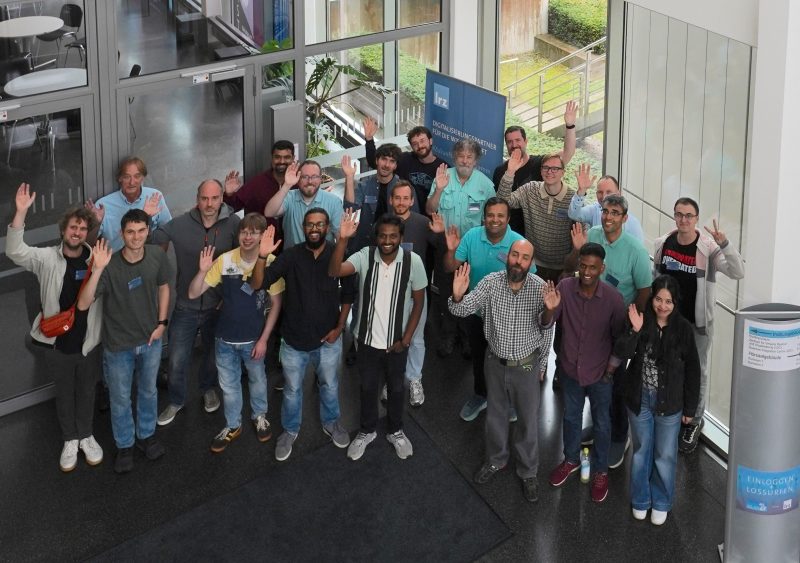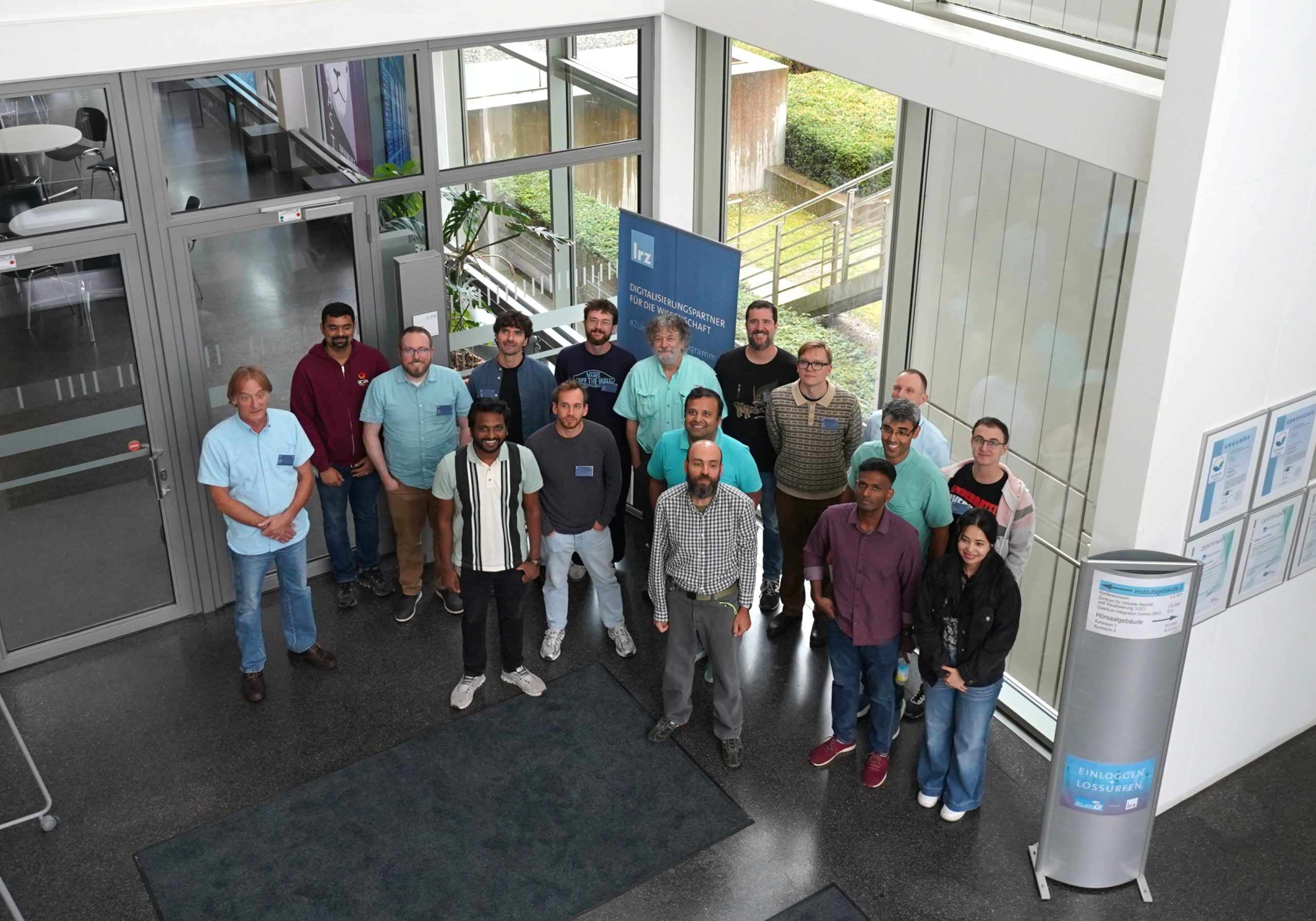
From 9 to 11 September 2026, the Leibniz Supercomputing Centre (LRZ), hosted the autumn hackathon of the Trillion Paramter Consortium. Organised by the EuroTPC, the hackathon gathered more than 30 researchers from leading European and US supercomputing centres and universities to turn ideas into practical solutions that make supercomputers more accessible and research projects more efficient.
Participants represented Argonne National Laboratory, the Barcelona Supercomputing Centre (BSC), CSC – IT Center for Science in Finland, CINECA in Italy, Ludwig-Maximilians-Universität München (LMU Munich) / Munich Centre for Machine Learning (MCML), Leipzig University, the High-Performance Computing Center Stuttgart (HLRS) and LRZ. Working in four teams, they used the three days to plan projects, test approaches and share experiences directly with potential collaboration partners.
Participants organised themselves in four working groups:
-
WG1: Develop workflows and agentic systems, collaborate on various implementations for Pandemic Preparedness Engine (PPX), a project funded from the Coalition for Epidemic Preparedness Innovations (CEPI).
-
WG2: Benchmark llama.cpp backends and GPU vendors for performance and energy efficiency across chat, reasoning, and vision-language models to find the most power-efficient hardware/software/model combinations.
-
WG3: Cost-aware LLM evolutionary algorithm design (multi-fidelity + Bayesian optimization + tiered model routing), benchmarked on GPU kernel-generation tasks on LRZ HPC infrastructure.
-
WG4: LLM-agent system that profiles HPC hardware, runs targeted micro-benchmarks, and suggests informed code optimizations grounded in real measurements.
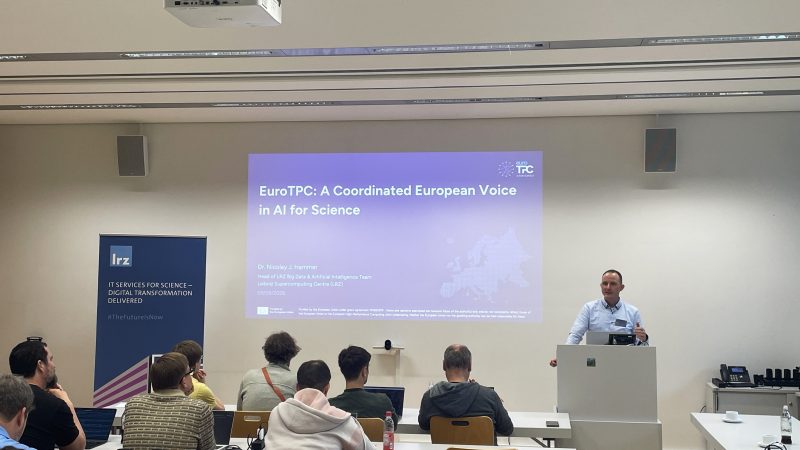
Presentation by Dr. Nicolay J. Hammer (Head of LRZ Big Data & Artificial Intelligence Team)
Agentic AI at the Center of the Hackathon
Agentic AI, in which large language models coordinate with other tools to process data and carry out actions, featured prominently throughout the hackathon. Contributions included:
-
Hypothesis generation for protein research: one team developed agentic workflows to support scientists in formulating new hypotheses
-
Access to HPC systems: a working group from the Gauss Supercomputing Centre (GCS) Agentic AI Focus group created initial workflows that enable an AI agent to adapt code to various supercomputers, making a wide range of HPC systems easier to use.
-
Security and trust: in light of initial incidents and risky system attacks by AI agents, the risks and boundary violations associated with agent-based systems were also on the agenda. A second working group from GCS Agentic AI Focus group developed secure strategies for authentication and authorisation workflows for AI agents, aiming to protect data and keep these digital assistants within defined boundaries
-
Energy efficiency: participants addressed the growing energy demand caused by inference calls in agentic systems and explored was to limit it. “The more Agentic AI is used, the more energy consumption increases due to inference calls,” notes LRZ researcher Ajay Navilarekal Rajgopal, “We need to limit that.”
Alongside the agentic AI focus, resources were dedicate to applying AI directly in research. A team from the Munich Centre for Machine Learning (MCML) investigated how researchers can use language models to formulate algorithms and develop them more quickly, while another group focused on risk prevention and pandemic preparedness.
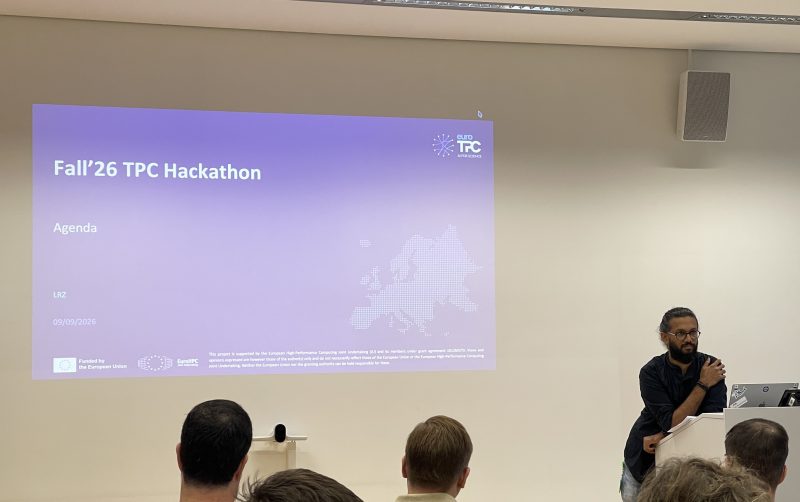
Presentation by Ajay Navilarekal Rajgopal (Computational Scientist - Big Data & AI, LRZ)
Hackathon Outcomes
The four working groups pursued different objectives. “Some wanted to develop an initial, simple prototype that they could continue working on separately, whilst others arrived with code that they wanted to optimize and expand upon. In any case, working together has led to progress” observed Rajgopal.
The hackathon also provided inspiration beyond these individual initiatives. Prof. Charles Catlett, a Senior Computer Scientist at Argonne National Laboratory (ANL) and a member of the TPC Planning and Strategy Team, prompted participants to consider how AI agents could safeguard and enrich urban life by analysing environmental data from cameras and sensors. In addition, the hands-on work helped build a network of contacts that AI specialists can turn to for practical advice in their day-to-day work.
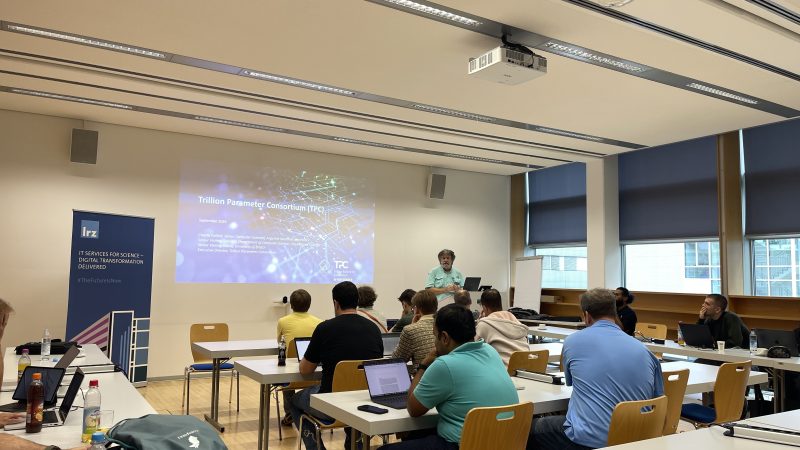
Presentation by Prof. Charles Catlett (Seranior Computer Scientist at Argonne National Labotory)
Voices from the Hackathon
Dr. Miguel Vazquez from the Barcelona Supercomputing Center and Dr. Arvind Ramanathan from ANL, who develop AI systems for bioinformatics and genomics research, gained new impetus, potential collaboration partners and ideas for projects at the LRZ. “The TPC community brings together a unique pool of expertise,” notes Vazquez. “This will enable us to successfully establish AI and agentic AI across all areas of research.”
LRZ leads the task of drawing up a roadmap for AI for science as part of the EuroTPC project. “To this end, we are currently gathering suggestions and topics from the EuroTPC’s advisory board and from researchers, and are using these to draft a strategy roadmap for the EU. LRZ has taken on the task of drawing up a roadmap for AI in science,” reports Dr. Nicolay Hammer, head of the LRZ’s Big Data & AI (BDAI) team.