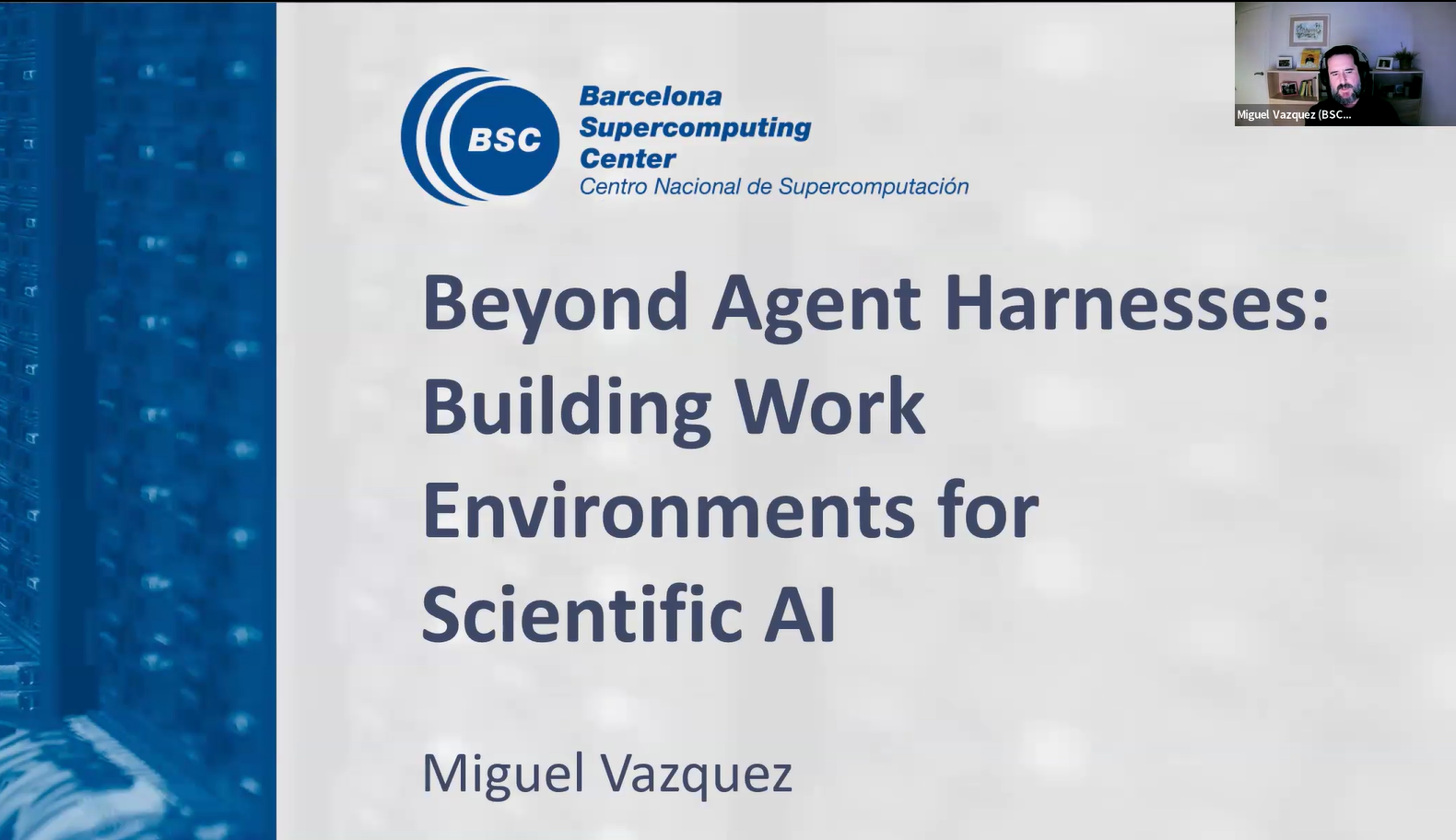
On 4 November, Miguel Vázquez, leader of the Genome Informatics group at the Barcelona Supercomputing Center (BSC), presented “Beyond Agent Harnesses: Building Work Environments for Scientific AI” as part of the TPC Seminar Series.
The talk explored a simple distinction. Agents are often designed around prompts, tools, skills and delegation, but these describe how an agent approaches work, not the work itself. Miguel argued that reliable scientific progress needs a durable, structured environment in which domain objects, operations, outputs and evidence have explicit identities and relationships.
Building on this idea, Miguel introduced SCIAS-LS, BSC’s Scientific Agent Suite for Life Sciences. It is an approach to building scientific agents around domain-specific tools, computational workflows and persistent scientific knowledge, rather than relying exclusively on general-purpose coding environments.
Highlights from the session included:
-
Comparing approaches to scientific AI. Using the AGS drug-response investigation as a case study, the talk examined what a general-purpose Claude-based agent can achieve from prepared scientific results, and what a more specialised scientific environment might add in terms of access to domain knowledge, mechanistic modelling and evidence-based reasoning.
-
Benchmarking and iterative development. The team evaluates not only scientific outputs but also how agents work, including tool use, delegation, resource consumption, evidence management and execution behaviour. This makes it possible to identify weaknesses and systematically improve the agent environment.
-
The evolution of agent doctrine. Miguel described how the instructions and operating principles that govern agent behaviour are developed and refined, covering scientific reasoning, collaboration, decision-making, tool use and evidence validation. Each iteration is informed by detailed analysis of real investigations, rather than by theoretical design or isolated software tests alone.
With SCIAS-LS, BSC’s Scientific Agent Suite for Life Sciences, we are exploring a different approach to scientific AI: building agents around science-specific tools and computational environments rather than relying primarily on general-purpose coding tools. At the same time, we are investigating structured scientific reasoning procedures to make the process of discovery more accountable, transparent and robust. Our goal is not simply to automate scientific analysis, but to create AI systems that can participate in scientific investigations, where their reasoning and evidence can be inspected, challenged and built upon by researchers.
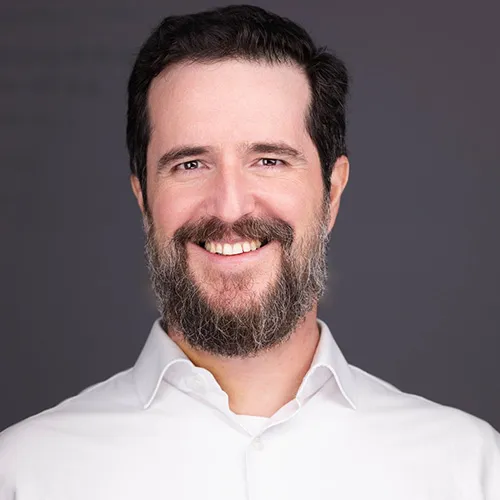 Miguel Vázquez, Genome Informatics Group Leader, BSC
Watch the recording: The seminar recording is available here.
To explore upcoming sessions, visit the TPC Seminar Series page.