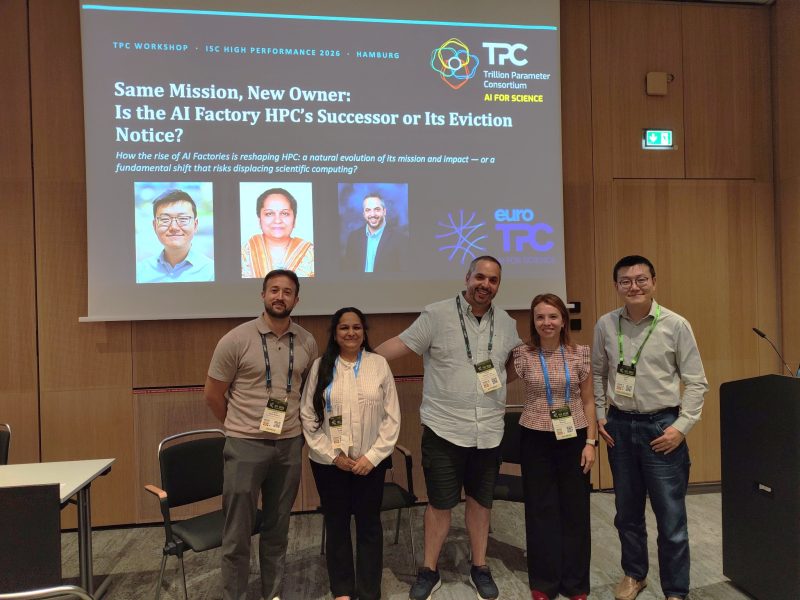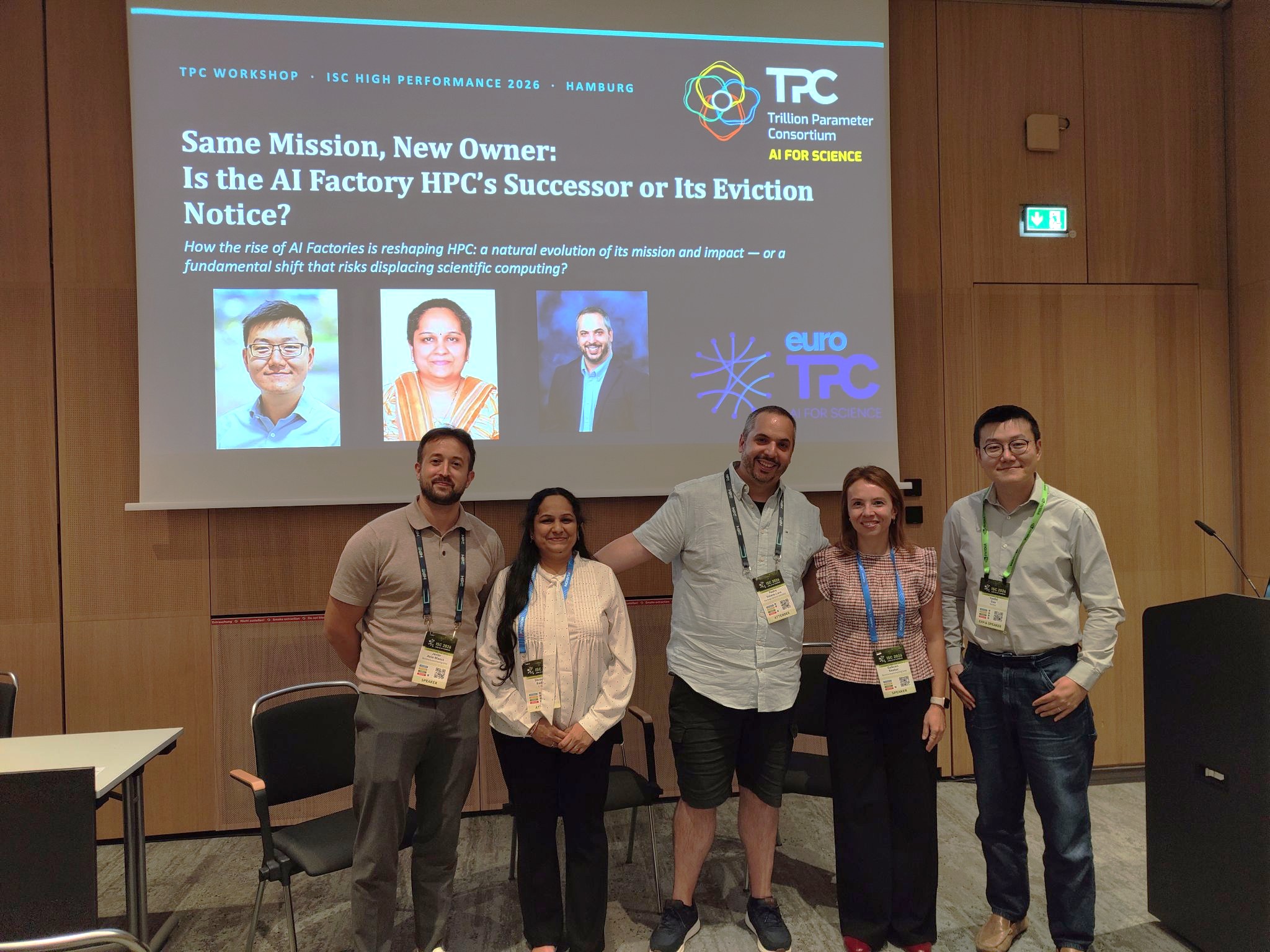
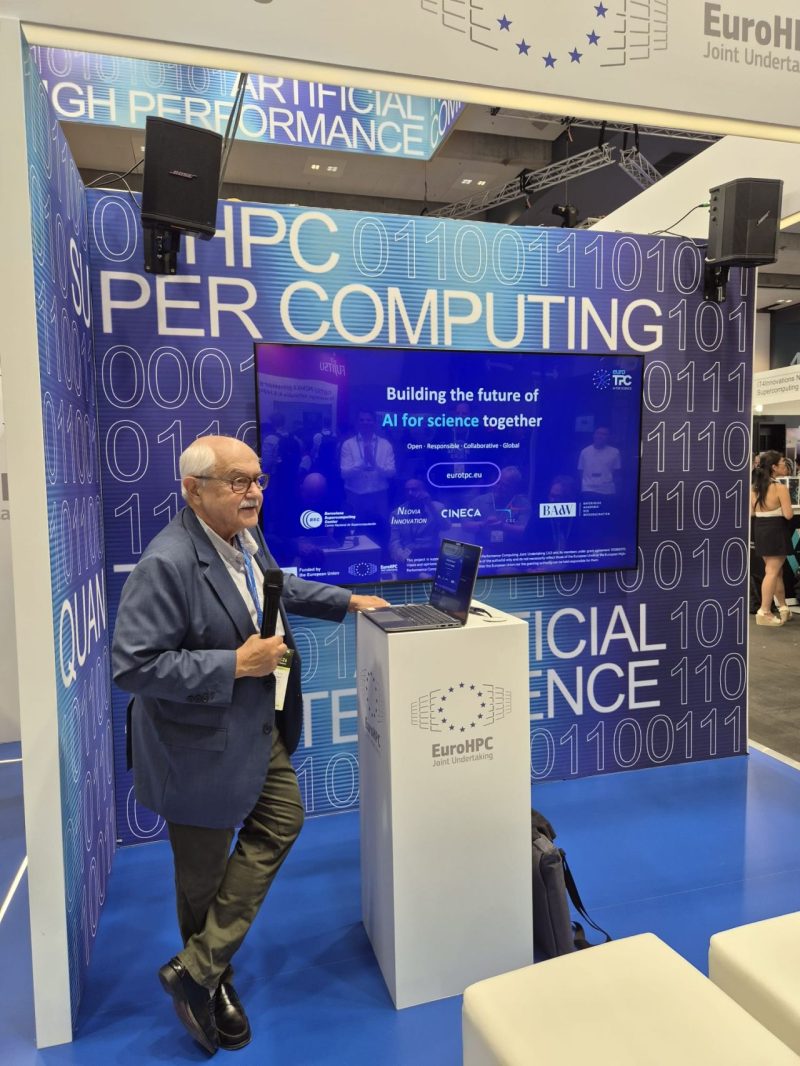
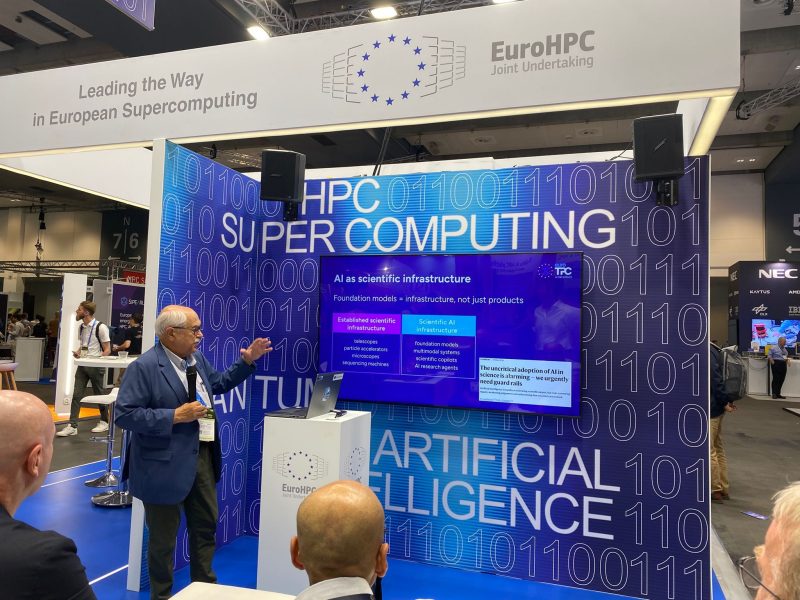
The ISC High Performance Conference took place in Hamburg, Germany, from 23 to 26 June 2026, bringing together the European and international high-performance computing, AI and quantum community. EuroTPC took part throughout the week, presenting at the EuroHPC Joint Undertaking booth and contributing to the 3rd Trillion Parameter Consortium (TPC) Workshop.
EuroTPC at the EuroHPC Booth
On 23 June, Fabrizio Gagliardi from the Barcelona Supercomputing Center (BSC) represented EuroTPC at the EuroHPC Joint Undertaking booth, delivering a presentation that shared the project’s vision for building the future of AI for science and explained why coordinated European action matters at this pivotal moment for AI and HPC.
The 3rd TPC Workshop: Bridging the AI and HPC Gap
The main highlight of the week was the 3rd Trillion Parameter Consortium Workshop, “Bridging the AI and HPC Gap”, held on Friday, 26 June. The session addressed one of the most pressing challenges in scientific computing: the growing misalignment between frontier-scale AI models and the realities of today’s HPC systems.
The workshop opened with an invited keynote from Rio Yokota of the Institute of Science Tokyo, who spoke on pre-training large language models at scale, covering distributed training, sparse expert models and synthetic data.
This was followed by a themed roundtable, “Same Mission, New Owner: Is the AI Factory HPC’s Successor or Its Eviction Notice?”, moderated by Gokcen Kestor of the BSC. The panel brought together Pedro Valero-Lara of Oak Ridge National Laboratory, Yanfei Guo of NVIDIA, and Shreeya Badhe of C-DAC, India, who offered contrasting perspectives on whether the emergence of AI Factories represents a natural evolution of HPC infrastructure or a fundamental challenge to its role.
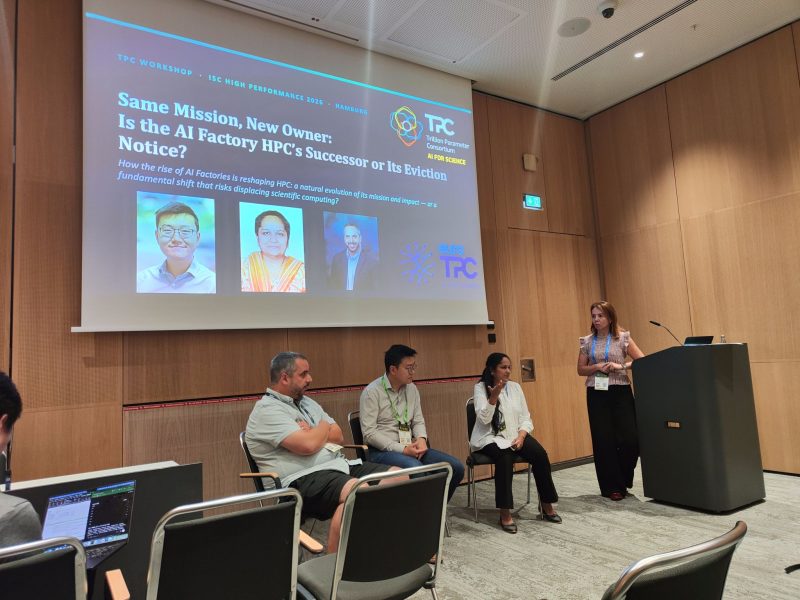
Themed roundtable moderated by Gokcen Kestor (BSC)
The afternoon session showcased five presentations spanning a wide range of topics, from synthetic biological reasoning problems to scalable large language model training and transparent energy profiling for frontier-scale AI:
- B. Hsu, C. Siebenschuh (ANL, United States), O. Gökdemir, B. Parrello, N. Getty, T. S. Brettin, R. L. Stevens, I. T. Foster, N. Chia & A. Ramanathan on “Generating Synthetic Biological Reasoning Problems at Scale on Heterogeneous HPC Systems”
- A. Navilarekal Rajgopal (LRZ, Germany) & N. Solmsdorf (Intel) on “A Scalable Recipe on SuperMUC-NG Phase 2: Efficient Large-Scale Training of Language Models”
- A. Oliveira-Filho, W. Silva-de-Souza, C. A. Valderrama Sakuyama & S. Xavier-de-Souza (UFRN, Brazil) on “Phoeni6: A Systematic Framework for Transparent and Reproducible Energy Profiling of Frontier-Scale AI”
- C. Siebenschuh (ANL, United States), B. Hsu, K. Hippie, A. Ramanathan, I. T. Foster & R. L. Stevens on “Scaling Structured Tensor Algebra for Time Series Foundation Model Training on Aurora”
- Y. K. Singh (C-DAC, India) on “Bridging Computation and Compassion: How C-FLOOD Transforms Disaster Response in India through HPC-AI Convergence”
Further discussions throughout the day touched on the full spectrum of the workshop’s themes: training trillion-parameter models on supercomputers, designing synthetic data pipelines as HPC workloads, practical integration challenges at HPC facilities, AI-assisted code generation and performance optimisation, and responsible, reproducible practice at scale. An open discussion on reproducibility, responsible compute usage and governance of shared infrastructure across Europe closed the session.
The workshop was co-organised by Javier Aula-Blasco (BSC), Murali Emani (Argonne National Laboratory), Eduardo Iraola and Gokcen Kestor (both BSC), and brought together researchers and practitioners from academia, government and industry to advance a shared understanding of how Europe and its global partners can align AI development with HPC infrastructure.